- Mar 17, 2026
- 4 min read
Rent or Buy, as a Spreadsheet Person
Built in 2025, revisited now: what I made, and what I’d do differently today.
Everyone has an opinion about renting versus buying.
Few people have a model.
In 2025, while looking at property myself, I built one in Python: a mortgage calculator that shows not just the monthly payment, but what happens to your net worth over the life of the loan.
The payment: French amortization
Most mortgages in Europe use French amortization: the same payment every month, where the share going to interest shrinks and the share going to principal grows.
M = P × r(1 + r)^n / ((1 + r)^n − 1)

P = amount borrowed
r = monthly interest rate (yearly rate / 12)
n = number of monthly payments (years × 12)
At the start, most of each payment is interest. That’s why the first years of a mortgage feel like renting from the bank.
Net worth starts below zero
The model tracks four lines over time: the property’s value, the principal still owed, the interest still to pay, and your net asset value (property value minus principal owed).
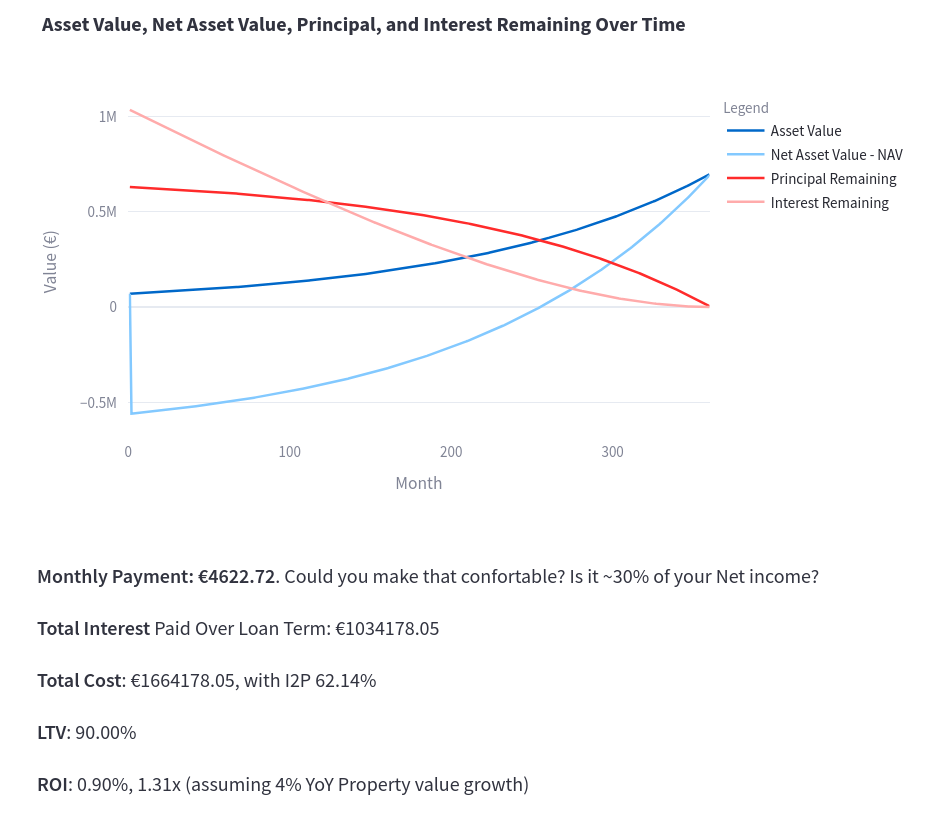
That chart is for one deliberately heavy example: a 90% loan-to-value mortgage over 30 years, with the property growing 4% a year. Three things stand out:
- Net worth starts far below zero. You own a flat and owe almost all of it.
- It takes about 20 years to cross zero in this case.
- Total interest exceeds the price of what was borrowed. The interest line starts above the principal line.
How deep and how long depends on three dials: the interest rate, the term and the loan-to-value. The model’s job is to let you turn them.
I left future interest out of net asset value on purpose (it isn’t owed until you keep the loan) but plotted it separately, so it can’t hide.
A flat is a stock with rent as its dividend
The framing that helped me most came from dividend investing:
| Stock | Property |
|---|---|
| share price | property value |
| dividend yield | rental yield |
| dividend growth | rent growth |
Seen this way, a dividend stock and a rented flat answer the same question: what yield do I get now, and how fast does it grow? Some stocks pay ~5.8% and grow it ~2.7% a year; others pay ~2.5% and grow it ~7.2%. Rents behave the same way, with one big difference: nobody gives you a 90% loan to buy dividend stocks. Leverage is what makes property both powerful and dangerous.
Nominal versus real
A friend told me her flat was worth more than 50% more than she paid in 2020. Impressive, until you do the maths:
CAGR = (end value / start value)^(1 / years) − 1
1.5x over 5 years ≈ 8% a year
Over the same years, inflation in Poland ran at roughly the same pace. In real terms, the flat costs about what it did in 2020, relative to everything else. It wasn’t a bad decision either: she lives in it, so she isn’t paying a rent that grew even faster. Both statements are true, and only a model shows them side by side.
What the spreadsheet didn’t tell me
Things I only learned by going through it:
- Buying costs are big and upfront. In Spain, roughly 6% in taxes, a few thousand in notary fees, and setup costs that scale with square metres.
- Furniture multiplies. What looks like one budget becomes four.
- Read the headline rate carefully. Spanish banks quote TIN (the bare interest rate) and TAE (the full cost with fees and insurance). Compare TAE.
- Currency mortgages are a trap. Poland’s Swiss-franc mortgages from the 2000s are a long lesson in borrowing in one currency and earning in another.
What I’d do differently now
- Model rent and buy together, with the rent you’d pay instead of buying invested elsewhere. “Buy versus nothing” is the wrong comparison.
- Everything in real terms by default, with nominal as the option.
- Ranges, not one number: a few rate and growth scenarios side by side.
- Ship it as a static calculator. The maths fits in the browser; nobody should need a server to see their own mortgage.
Not financial advice. It’s a model to think with, not a recommendation.
Takeaways
- Look at net worth over time, not just the monthly payment.
- Rate, term and loan-to-value decide how deep and how long you’re underwater.
- Rent is the property’s dividend; leverage is the difference.
- Always convert to real terms before celebrating a price rise.